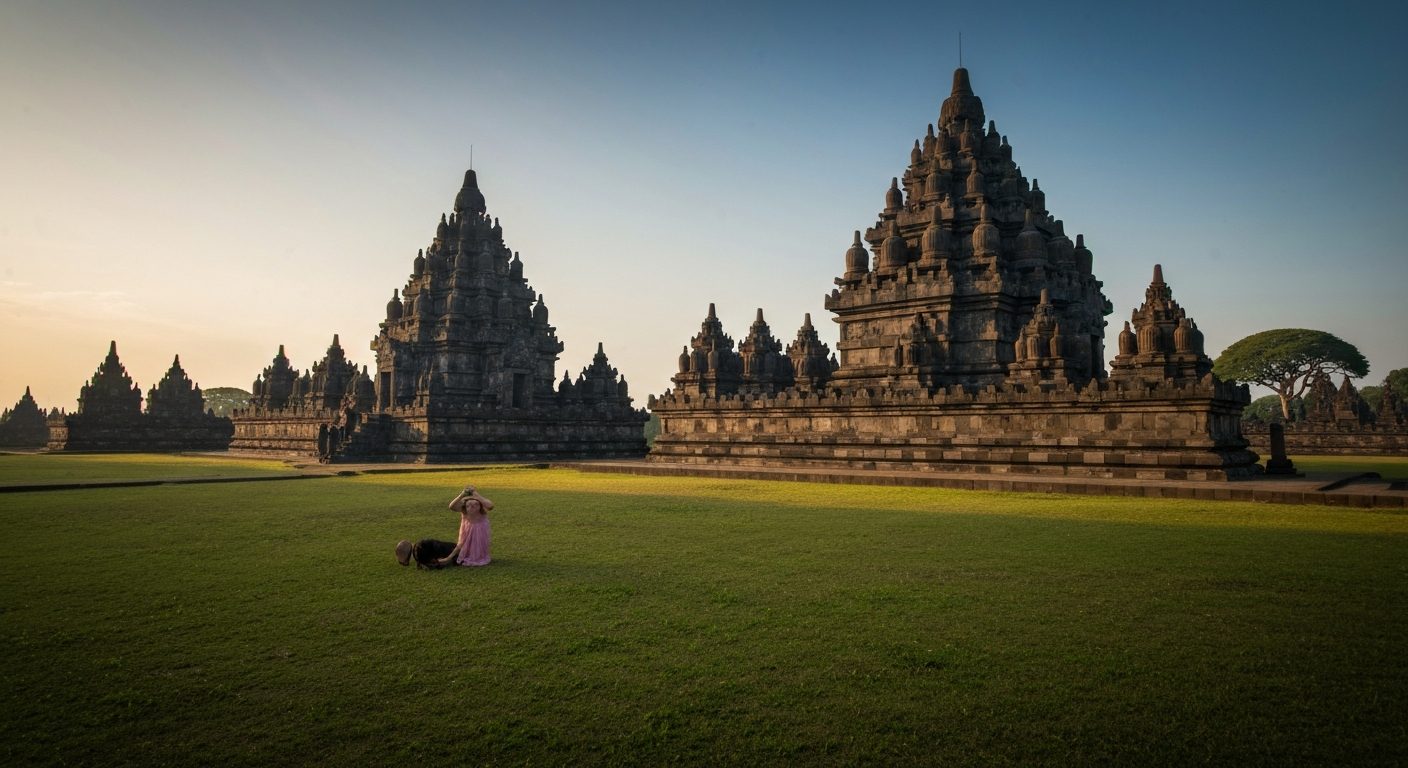
Prambanan temple history is the story of a 9th‑century Hindu royal complex built on the plains east of Yogyakarta, dedicated to the Trimurti – Shiva, Vishnu and Brahma. Today the Prambanan Temple Compounds form the largest Hindu temple site in Indonesia and a UNESCO World Heritage landscape, where reliefs of the Ramayana still guide how we tell stories on stage and in everyday Javanese culture.
What is Prambanan? A clear definition and location on the Yogyakarta map
Prambanan is a Hindu temple complex from the 9th century, built during the Sanjaya dynasty of the Mataram Kingdom in Central Java. The core compound is dedicated to the Trimurti – Shiva as the central and tallest candi (temple), flanked by Vishnu and Brahma.
On a modern map, the Prambanan temple complex location sits:
- About 17 km northeast of central Yogyakarta (around 30–45 minutes by car in normal traffic).
- Straddling the administrative border of Yogyakarta Special Region and Central Java.
- Along the main Yogyakarta–Solo (Surakarta) road, with access from both cities.
If you look at a prambanan temple complex location map Yogyakarta tourism offices use, you will see:
- Prambanan just south of the Opak River.
- Mount Merapi to the north, forming a straight north–south axis with the temple.
- The Kraton Yogyakarta and Taman Sari to the southwest.
- Borobudur far to the northwest, across the Progo River valley.
For trip planning, this means you can pair Prambanan with:
- Morning at the Kraton and Taman Sari, then late afternoon at Prambanan.
- Sunrise on Merapi’s slopes, then a midday or sunset visit to Prambanan.
- Or a separate day from Borobudur, which is in the opposite direction.
Our Bali Premium Trip reservations team usually suggests 3–4 hours inside the Prambanan Archaeological Park itself, plus transfers, for a relaxed visit.
A brief timeline: Prambanan Temple history and facts
Prambanan temple history and facts are drawn from Old Javanese inscriptions, architectural study and later chronicles. The dates below are what most scholars and Indonesia’s heritage authorities accept today.
Founding in the 9th century (Sanjaya dynasty of Mataram)
- Around 850 CE: Construction begins, most likely under Rakai Pikatan of the Sanjaya dynasty, rulers of the Hindu Mataram Kingdom in Central Java.
- The temple is known in inscriptions as “Siwagrha” – “The House of Shiva”.
- The complex is set out as an enormous sacred mandala with hundreds of temples, celebrating Shiva as the main deity while also honoring Vishnu and Brahma.
Some prambanan temple facts from this early period:
- The central Shiva temple reaches 47 meters high.
- Originally, the full complex had 240 temples of various sizes.
- The plan follows a square, concentric layout, typical of Hindu-Javanese candi design of the era.
Prosperity, then decline as power shifts to East Java
- Late 9th – early 10th century: Prambanan is expanded and richly decorated; more ancillary shrines and pervara (guardian) temples are added.
- Mid–10th century onwards: The political center of Mataram moves toward East Java, for reasons still studied – volcanic activity, economic routes, and dynastic shifts all likely played a part.
As royal patronage moved away, major ritual life at Prambanan faded. Temples without continuous maintenance, especially in a humid and seismic area, start to deteriorate.
Earthquakes, volcanic forces and gradual abandonment
Central Java sits on active fault lines, and the plains around Prambanan are exposed to both earthquakes and volcanic ash from Merapi. Over many centuries:
- Repeated earthquakes damaged the tall, slender structures.
- Vegetation swallowed fallen stones and unmaintained shrines.
- Local villages reused carved stones in house foundations and smaller shrines.
By the time early European travelers wrote about the site in the 18th–19th centuries, much of Prambanan was a jumble of blocks. Only the tallest central structures still stood recognizably.
Rediscovery, Dutch-era “cleaning” and 20th‑century restoration
- 18th century: The complex is noted by Dutch officials, but systematic work is slow.
- 19th century: Stones are catalogued and some basic consolidation work happens, though early interventions were not as careful as modern conservation standards.
- 1930s–1950s: Serious archaeological restoration begins, including anastylosis – carefully reassembling buildings from original stones, adding new stone only where necessary for stability.
- 1953: The restored Shiva temple is officially inaugurated.
- Late 20th century: More temples in the inner zone are restored, and the surrounding landscape is cleared to reveal the full scale of the mandala layout.
Earthquakes have continued to shape prambanan temple history. A strong quake in May 2006 caused new damage, especially to the upper parts of several temples. Since then:
- Structural reinforcements have been added.
- Access to some upper chambers has been restricted for safety and conservation.
- Ongoing monitoring and restoration continue under Indonesia’s heritage authorities.
Prambanan UNESCO World Heritage status
In 1991, Prambanan was inscribed as part of the “Prambanan Temple Compounds” on the UNESCO World Heritage list. This inscription covers:
- The main Prambanan (Loro Jonggrang) complex.
- Several related groups in the surrounding archaeological zone, including Lumbung, Bubrah and Sewu temples.
Prambanan UNESCO World Heritage criteria focus on:
- Its outstanding example of Hindu architecture and temple design in Java.
- The high artistic achievement of its stone reliefs and statues.
- Its importance as a major center of Hindu culture in island Southeast Asia.
For you as a visitor, UNESCO status means conservation rules are strict. Access, pathways and restoration work are managed first around heritage protection, then visitor convenience.
Prambanan temple architecture and temple design: How a Hindu-Java candi works
Prambanan temple architecture and temple design represent the peak of Hindu-Java architectural creativity in the 9th century. The word “candi” in Indonesia refers broadly to ancient temples from Hindu-Buddhist periods, and Prambanan is the most elaborate Hindu candi complex in the country.
The mandala layout: 240 temples in concentric squares
Prambanan is planned as a giant mandala – a sacred diagram. From above, you would see:
- An almost perfect square, aligned to the cardinal directions.
- Three main zones:
- An outer open area, once containing rows of 224 pervara temples.
- A middle terrace with 8 smaller temples.
- An inner courtyard with the 8 principal temples and several minor shrines.
Only a fraction of the 224 pervara temples have been reconstructed; many remain as foundations and stone piles, deliberately left that way to avoid guesswork.
This layout mirrors Hindu cosmology:
- The outer zones represent the human and worldly realm.
- The middle zone represents the domain of holy beings.
- The innermost terrace represents the realm of the gods, with Mount Meru at the center – symbolized by the towering Shiva temple.
The Trimurti temples: Shiva, Vishnu, Brahma
In the inner courtyard stand three main shrines on the west side, facing east:
- Shiva Mahadeva Temple (47 m tall)
- Vishnu Temple (about 33 m)
- Brahma Temple (about 33 m)
Opposite each main deity, on the east side, is a smaller “vehicle” temple:
- Nandi Temple (for Shiva’s bull mount, Nandi)
- Garuda Temple (for Vishnu’s eagle-mount, Garuda)
- Hamsa/Angsa Temple (for Brahma’s swan/ goose-mount)
This arrangement reinforces Trimurti devotion and the relationship between each god and their vahana (vehicle).
Vertical symbolism: From base to peak
Each main temple follows a similar vertical structure:
- Foot (batur): The square base, symbolizing the earthly world.
- Body (tubuh): The tall, tiered chamber area, where cellas (inner sanctums) house main statues.
- Roof (atap): A series of increasingly smaller layers, crowned by a large, ribbed finial (amalaka and stupa-like element).
The profile is sharply vertical and pointed, a hallmark of prambanan temple hindu java architecture as distinct from the broad, terraced profile of nearby Buddhist Borobudur. Standing under the main Shiva temple, the eye is drawn dramatically upward – exactly as the architects intended, directing the mind from earth toward the divine.
Sculptural program: Kala, makara and celestial figures
Hindu-Javanese temple design blends Indian religious motifs with local artistic preferences. Across Prambanan’s facades you will see:
- Kala heads above doorways: a fierce, fanged face without a lower jaw, guarding the threshold. In Java, Kala is associated with time and protective power.
- Makara creatures at stair balustrades: part crocodile, part fish, part dragon, bridging ocean and river symbolism from India with local water spirits.
- Devata and apsara figures: graceful celestial beings carved in high relief, holding flowers or musical instruments.
- Flying vidyadhara and kinnara: semi-divine narrative characters from Hindu–Buddhist cosmology.
On a quiet visit, spending 15–20 minutes just walking around one main temple slowly, studying faces and hand positions, gives a better sense of how Javanese craftsmen saw the divine.
Inside the temples: Deities, statues and ritual orientation
Shiva temple: The core of Prambanan
The Shiva temple is the heart of the complex. It has:
- Four stairways and four entrances, aligned to the cardinal directions.
- A central cella containing a statue of Shiva Mahadeva as the supreme deity.
- Three side cellas for:
- Durga (north) – as Mahisasuramardini, slayer of the buffalo demon.
- Agastya (south) – a sage associated with Shiva.
- Ganesha (west) – the elephant-headed remover of obstacles.
For many Javanese visitors, the Durga statue is also associated with the local legend of Roro Jonggrang, which gives Prambanan its popular name. Guides often tell this story on-site:
- A prince, Bandung Bondowoso, forced Roro Jonggrang to marry him.
- She set an impossible condition: build 1,000 temples in one night.
- He nearly succeeded with help from spirits, so she tricked them by simulating dawn.
- In anger, he cursed her into stone – identified with the Durga statue.
This folklore is not recorded in 9th‑century inscriptions, but it layers Javanese storytelling onto the older Hindu icon.
Vishnu and Brahma temples
The Vishnu and Brahma temples are smaller but follow a similar layout:
- One main cella each, containing statues of the deity.
- Peripheral chambers and higher levels accessible via steep stairs (access can be restricted depending on current conservation rules).
In daily use during the Mataram era, these shrines would have held regular offerings and ritual processions coordinated between the three temples, affirming the unity of Trimurti worship.
Secondary shrines and smaller temples
The Nandi, Garuda and Hamsa temples once housed vehicle statues; some original pieces are still in place, others are in museums. Around the inner and middle zones you also find:
- Apit temples: “flanking” shrines on the north–south axis.
- Kelir and patok shrines: minor boundary markers and screen temples.
Each has a role in structuring movement, marking thresholds and reinforcing the cosmic diagram as you walk the compound.
Ramayana reliefs: Prambanan Ramayana significance from stone to stage
One of the most compelling aspects of Prambanan temple Hindu cultural significance is how its narrative reliefs still shape performance traditions.
Where to find the Ramayana on the temple walls
The Ramayana epic is carved in bas‑relief around:
- The exterior of the Shiva temple’s inner gallery (first sequence).
- Continuing on the Brahma temple (second sequence).
- Additional related stories and Krishna–Kresna legends appear on the Vishnu temple.
To read it “properly”:
- Start on the east side of the Shiva temple.
- Walk clockwise (pradaksina), keeping the temple on your right.
- Follow the panels as they unfold key episodes: Rama’s exile, the abduction of Sita, Hanuman’s journey to Lanka, the great battle, and Sita’s ordeal.
Guides trained in the text can point out:
- How Javanese versions of the Ramayana differ slightly from Indian tellings.
- Details like forest animals, palace courtiers, and architectural forms that mirror 9th‑century Central Java life more than India itself.
From carved epic to dance-drama: The Ramayana Ballet
The modern Ramayana Ballet performances near Prambanan are a direct cultural descendant of these reliefs. While choreography and staging have evolved in the 20th century, the storyline follows the Javanese Ramayana tradition inscribed in stone.
Prambanan Ramayana significance today includes:
- Serving as a script: choreographers map episodes to temple panels.
- Providing visual references for costumes and architecture used on stage.
- Offering a ritual link: performances are staged within sight of the temple where the story is carved.
The open-air Ramayana stage just south of the complex (with Merapi and the lit temples as backdrop on clear nights) is one of the most atmospheric venues in Yogyakarta. From a planning perspective:
- Dry-season evenings (roughly May–September) are usually preferred for outdoor shows.
- Indoor venues are used in the rainy months or for certain schedules.
- Typical performance durations run 2–2.5 hours, including intermission.
If you plan a day around this:
- Visit Prambanan in the late afternoon, watch the reliefs as daylight softens.
- Have an early dinner nearby.
- Then attend the evening ballet, seeing episodes you just studied on the stone.
Our team at Bali Premium Trip can plan your trip so a private guide walks you through the reliefs in the late afternoon, then helps you navigate to your seats for the performance. Many guests coordinate this easily over WhatsApp with our Yogyakarta planning desk.
Cultural significance: Prambanan as a Hindu site in a largely Muslim Java
Today, most Javanese are Muslim, yet Prambanan temple Hindu cultural significance remains strong in several ways.
Shared heritage, not sectarian boundary
Locals around Prambanan commonly treat the temples as part of Javanese heritage as a whole, not only as a Hindu religious site. Everyday practices include:
- Muslim and Christian families visiting on weekends as an outing and history lesson.
- Hindu pilgrims from Bali and other parts of Indonesia coming for prayer.
- School excursions that teach national history and cultural diversity.
You will see school groups reciting facts about the Mataram Kingdom right next to Indian visitors offering incense to Shiva. This coexistence is normal here.
Ongoing ritual life
Although the complex is not a daily parish temple, it does host important Hindu ceremonies:
- Galungan and Kuningan (Balinese Hindu festivals) sometimes see special prayers.
- Nyepi (Balinese Day of Silence) can be preceded by ritual events such as Melasti held at or near major temples.
- Specific Javanese–Hindu observances coordinated with Parisada Hindu Dharma Indonesia (Hindu council) may use Prambanan as a sacred point.
For these, parts of the complex might be set aside briefly; visitors are still welcome but asked to respect ritual boundaries, avoid obstructing processions and dress modestly.
Javanese identity, dance and wayang
Beyond religion, Prambanan influences:
- Classical Javanese dance vocabulary used in the Ramayana Ballet.
- Wayang kulit (shadow puppet) stories based on Ramayana and Mahabharata cycles.
- Visual motifs in batik and contemporary design – stylized candi silhouettes, kala heads, and winged Garuda forms.
For many Yogyakarta artists, Prambanan is not just a historical site but part of their mental landscape, as present as the Kraton and Taman Sari.
Prambanan Temple vs Borobudur: Key differences for visitors
Many travelers plan both headline temples in Yogyakarta. A simple set of prambanan temple facts compared with Borobudur can help shape your days.
| Aspect | Prambanan | Borobudur |
|---|---|---|
| Religious tradition | Hindu (Trimurti: Shiva, Vishnu, Brahma) | Buddhist (Mahayana) |
| Main profile | Tall, pointed candi towers | Broad, stepped pyramid with domes |
| Core era | 9th century Mataram (Sanjaya dynasty) | 8th–9th century Sailendra dynasty |
| Key narratives | Ramayana, Krishna stories | Jataka tales, Buddha’s path |
| Layout shape | Square mandala with 240+ temples | Square base with circular upper terraces |
| Typical visit length | ~3 hours in the park | ~3 hours in the park |
Most visitors who see both say:
- Prambanan feels more vertical and sharp, with dramatic silhouettes at sunset.
- Borobudur feels more introspective and geometric, particularly at dawn.
Both are part of Java’s layered Hindu–Buddhist past and are managed as separate UNESCO World Heritage properties.
Practical orientation: Visiting the Prambanan Temple Compounds today
This article is about heritage, not ticket logistics, but a few practical pointers help bridge prambanan temple history and facts with what you experience onsite.
How much time to allow
For a thoughtful visit covering:
- Main Prambanan (Loro Jonggrang) complex.
- A walk through the pervara temple fields and viewpoints.
- Optional side visits to Candi Sewu or Lumbung (in the same archaeological park zone).
Plan for:
- 3–4 hours inside the park.
- Plus travel time from Yogyakarta city (30–45 minutes each way, longer in peak hours).
If you add the Ramayana Ballet in the evening, your total outing can comfortably fill 6–7 hours door-to-door.
Guides, interpretation and what you’ll actually see
On site you will find:
- Official park signage in Indonesian and English, giving brief explanations.
- Some audio-visual displays near the entrance or museum area (content can vary over time).
- Optional local guides offering their services at the gate.
With a private guide arranged in advance, you can:
- Read key inscriptions and reliefs in order, not just snap photos.
- Connect elements of prambanan temple architecture and temple design with Hindu concepts.
- Understand what is original stone, what is modern reinforcement, and where ruins have been deliberately left un-rebuilt.
Bali Premium Trip arranges licensed, vetted guides who know both formal history and local stories. You book directly with our own reservations team, at transparent, published rate ranges, and we in turn arrange tickets, guides and transport through licensed Yogyakarta operators. We do not own the park or any exclusive concessions; our role is coordination and curation.
Indicative costs (last verified June 2026, excluding park entry fees):
- Half‑day private Prambanan tour from Yogyakarta with car, driver and guide: around US$80–160 total for 2–4 people, depending on vehicle type and language needs.
- Combined Prambanan + Ramayana evening program with transfers and guiding: around US$120–230 total for 2–4 people, depending on seating category, season and show schedule.
These are working ranges to help you budget; our team will confirm exact current pricing and inclusions once you share date and group details over email or WhatsApp.
Physical layout and walking effort
Distances and effort are moderate:
- From main gate to inner temple courtyard: roughly 500–800 meters of walking, depending on route and internal shuttle use.
- Exploring the inner courtyard: mostly flat, but with uneven stone surfaces and some steep stairs if upper levels are open.
- Total walking distance for a full visit can easily reach 3–4 km.
Families with younger children usually manage well, especially with breaks and an early or late-day schedule to avoid midday heat.
Why Prambanan matters for your Yogyakarta itinerary
For many visitors, understanding Prambanan temple history and facts transforms it from “another old temple” into a living reference point. It gives you:
- A concrete picture of 9th‑century Hindu Java – its architecture, artistry and royal ideology.
- A bridge between archaeological stone and living arts like the Ramayana Ballet and wayang.
- A quiet counterpoint to the livelier streets of Malioboro and the formal refinement of the Kraton.
For Javanese like me who have walked these grounds for years, Prambanan is a place to slow down. To trace with the hand the same relief lines stone‑cutters carved more than a thousand years ago. To watch Merapi at a distance and remember how earth, politics and faith all shaped this landscape.
If you would like help weaving Prambanan into a wider Yogyakarta plan – perhaps with Merapi jeeps at dawn and Borobudur on a separate day – our team at Bali Premium Trip can map out the days, secure guides and transfers, and keep your timing realistic. You can plan your trip directly with us over email or WhatsApp; we keep the conversation practical and unhurried.
Quick reference: Essential Prambanan Temple facts
- Primary name
- Prambanan (also Loro Jonggrang; official UNESCO name: Prambanan Temple Compounds)
- Religion
- Hindu (Trimurti focus: Shiva, Vishnu, Brahma)
- Founding era
- Mid‑9th century CE, Sanjaya dynasty of the Mataram Kingdom
- Peak height
- Shiva temple – about 47 meters
- Total original temples
- 240 (16 main + 224 pervara in outer rings)
- Location
- ~17 km northeast of Yogyakarta city, along the road to Solo (Surakarta)
- World Heritage status
- UNESCO World Heritage, inscribed 1991
- Main narratives in reliefs
- Ramayana epic, with additional Krishna legends on Vishnu temple
If you are ready to turn this context into a concrete travel plan, our Yogyakarta specialists at Bali Premium Trip are happy to help align history, timing and comfort – from private guides at Prambanan to coordinated transfers across the city and countryside. Share your dates and interests via email or WhatsApp through our plan your trip page, and we will work from there.
FAQs: Prambanan Temple history, architecture and visiting
Is Prambanan older than Borobudur?
Borobudur likely began earlier, in the late 8th century, under the Sailendra dynasty, and reached its mature form by the early 9th century. Prambanan’s major construction is generally placed slightly later in the 9th century under the Sanjaya dynasty of Mataram. So in broad terms, Borobudur is a little older, while both belong to the same general historical period of Central Java’s Hindu–Buddhist kingdoms.
Who built Prambanan Temple?
Prambanan is attributed to the Hindu rulers of the Sanjaya dynasty of the Mataram Kingdom, with Rakai Pikatan often named as the king who initiated the major building program around the mid‑9th century CE. Later kings expanded the complex, but exact attributions for every temple are still the subject of scholarly research.
Why is Prambanan a UNESCO World Heritage site?
Prambanan was inscribed on the UNESCO World Heritage list because it is the largest and most sophisticated Hindu temple complex in Indonesia, a masterpiece of Hindu-Javanese architecture, and an important witness to the cultural history of Southeast Asia. Its elaborate mandala layout, the height and refinement of the Shiva temple, and the narrative Ramayana reliefs all contribute to its outstanding universal value.
How is Prambanan different from temples in India?
While Prambanan draws on Indian Hindu concepts, its architecture is distinctly Javanese. The candi towers use local proportions and decorative styles, with features like kala heads and makara that have a Central Javanese flavor. The Ramayana reliefs also depict clothing, buildings and landscapes that look more like 9th‑century Java than India. In that sense, Prambanan is a local reinterpretation of shared Hindu ideas, not a copy of an Indian temple.
Can I visit Prambanan and see the Ramayana Ballet in one day?
Yes. Many visitors explore the Prambanan complex in the afternoon for 2.5–3.5 hours, have an early dinner nearby, then attend the evening Ramayana Ballet performance at the adjacent theater. Transfers, guiding and tickets can be coordinated as a single program. Our Bali Premium Trip team often organizes this format, with WhatsApp updates on show times and weather so you do not have to manage the logistics alone.