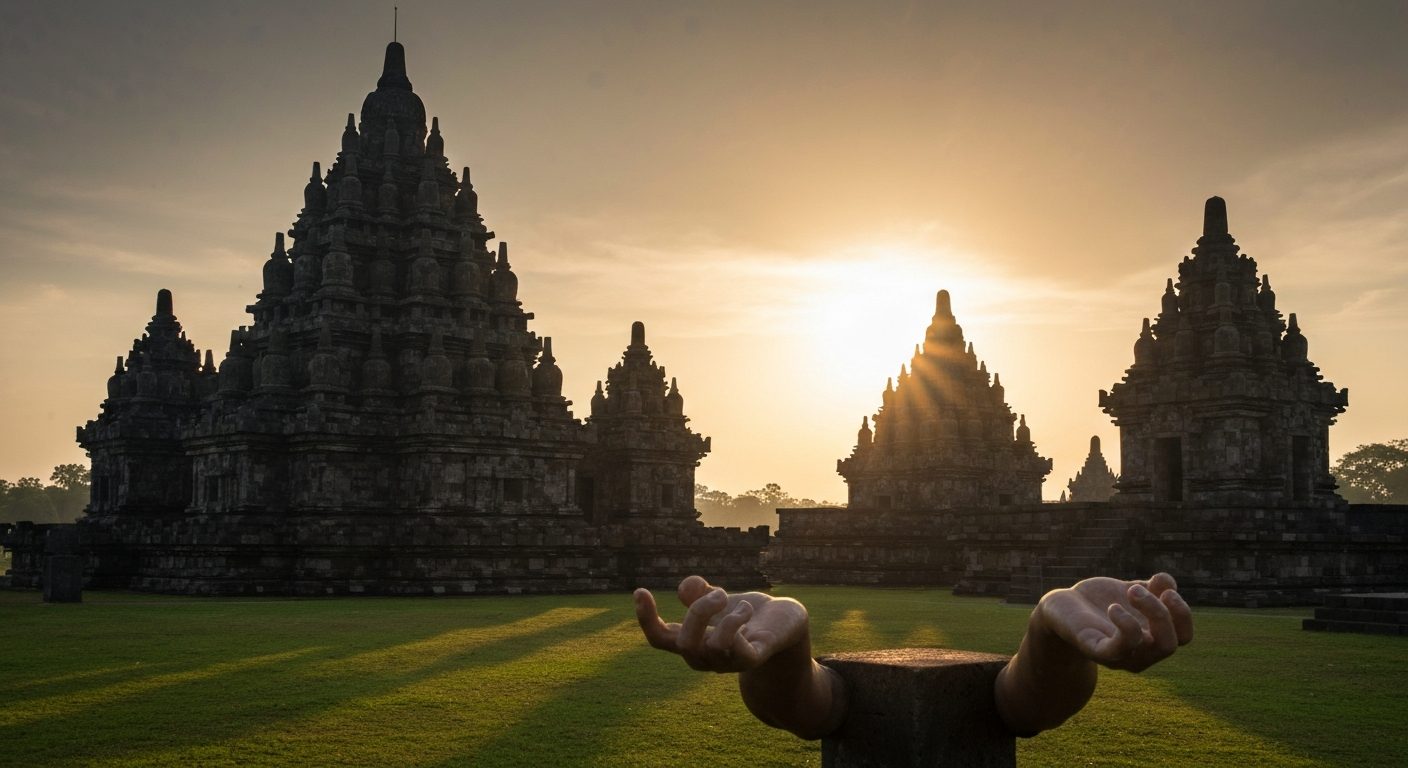
A prambanan sunrise tour from yogyakarta is an early-morning visit to Prambanan temple timed for golden hour light, either from within the temple complex or from higher viewpoints such as Ratu Boko. It’s primarily about light and angles, not just arriving “early.”
Most visitors see Prambanan in harsh late-morning sun, then wonder why their photos feel flat. With a bit of planning, you can time sunrise or sunset so the stone reliefs, central spires and Merapi backdrop all line up the way you’ve seen in the postcards.
Prambanan Sunrise vs Sunset: Which Actually Works Better?
Let’s start with the big decision: prambanan sunrise vs sunset. Both can work, but they give different types of images and require different logistics.
| Aspect | Sunrise at/around Prambanan | Prambanan temple sunset photography tour |
|---|---|---|
| Light direction | Soft, low-angle light from the east, with warm tones on western faces of the temples. | Warm sidelight or backlight on the western side; good for silhouettes and rim light on reliefs. |
| Access reality | No official pre-dawn entry to inner complex; shots are usually from outside or higher viewpoints. | Full access to the complex during public hours; golden hour typically overlaps with opening times. |
| Crowd levels | Lower crowds in the first hour after opening; outside viewpoints can be quiet. | Highest visitor numbers 15:30–17:00; still manageable with a good route and timing. |
| Iconic shots | Silhouette of temple line from a distance, mist over the plain, Merapi (if clear). | Close-up temple details in golden light, people-in-frame shots, and Ratu Boko sunset silhouettes. |
| Typical add-on | Borobudur sunrise / early Borobudur visit, then onward to Prambanan late-morning. | Ramayana Ballet at Prambanan open-air theatre after sunset. |
Because the park opens around 06:00–06:30 (last verified June 2026, opening hours subject to official changes), a true sun peeking over the horizon behind the temples while you stand in the courtyard type of sunrise is not realistic on normal tickets. That’s the key mistake many photographers make.
For most travellers who want reliable, close-up temple images, a prambanan temple sunset photography tour is actually more practical. You get control inside the complex during golden hour, then can continue to the Ramayana ballet performance afterward.
Sunrise & Sunset Timing by Season (Yogyakarta)
Yogyakarta sits near the equator. Day length doesn’t swing as dramatically as in Europe or North America, but sunrise and sunset do shift by around 30–40 minutes across the year.
- Approximate sunrise time
- 05:25–05:45 throughout the year.
- Approximate sunset time
- 17:30–17:50 throughout the year.
- Best golden hour window (morning)
- Roughly 06:00–07:00, once the park opens.
- Best golden hour window (evening)
- Roughly 16:30–17:45, with the warmest light usually 30–10 minutes before sunset.
From my field notes (last checked June 2026):
- June–August: Drier air, clearer sunrise and sunset more often, but also a busier season for domestic and regional visitors.
- December–February: Rainy season; you can still get excellent golden hour light between showers, but clouds and sudden downpours are common. Always plan a rain cover for your gear.
- Ramadan and national holidays: Afternoon crowds can spike due to domestic tourism, affecting composition options more than light quality.
We can’t control clouds, haze or volcanic conditions, and we never promise “perfect sky” shots. What we can control is being in the right area of the park at the right time, which is what this guide focuses on.
The Four Key Shooting Scenarios Around Prambanan
I think about Prambanan in four photography “modes” rather than just sunrise or sunset:
- Close temple detail in warm sidelight.
- Mid-distance ensemble shots of the central group.
- Far-distance silhouettes with sky drama.
- Context shots with human activity or performance (like Ramayana ballet).
Here’s how to build a prambanan temple photography tour around those modes.
Best Places Inside Prambanan for Golden Hour Photos
1. Brahma & Vishnu Temple Terraces (Side-Light Detail)
The three main temples facing east are Shiva (center, tallest), Brahma (south), and Vishnu (north). For photographers, Brahma and Vishnu are your main platforms.
- Timing: Late afternoon, around 16:30–17:15.
- Best light: Western facades glowing with low sun; strong shadows to show relief depth.
- Shot types: 24–70mm detail of reliefs, 35mm environmental portraits, 16–35mm wide shots of staircases with people for scale.
Because access to the upper terraces can be restricted or rotated for preservation reasons, your exact vantage point may change seasonally. Licensed local guides usually know, on any given week, which stairways are open and how strict the time limits are.
2. East Lawn & Candi Field (Ensemble Shot of the Central Group)
Walk out to the eastern lawn or the grassy open area with scattered small shrines (candi) and turn back toward the main complex. This is how you frame the classic “row of temples rising from the plain” shot.
- Timing (sunrise mode): First hour after park opening, around 06:00–07:00.
- Timing (sunset mode): Around 16:30–17:15, when light rakes across the full group.
- Lenses: 24–70mm or 35mm prime to keep the temples proportional and avoid huge distortion.
At sunrise, the light comes from behind you as you face west, giving even illumination across the temple facades with long shadows stretching toward you. At sunset, light shifts to more of a side angle, which works better for reliefs than for clean silhouettes.
3. Peripheral Temples (Sewu & Lumbung for Calm Compositions)
Many visitors skip Candi Sewu and Candi Lumbung, yet they’re quieter and give you clearer lines and fewer people in frame. They’re a short walk or shuttle ride within the same park zone.
- Timing: Early morning or late afternoon, ideally 07:00–08:00 or 15:30–16:30.
- Why: Softer lines, less clutter, and good practice for composition without crowd pressure.
If you’re planning a meticulous photography session, I often suggest starting at the main group, then moving to Sewu as the light gets higher, or reversing that for a late-afternoon yogyakarta sunset photography tour prambanan loop.
Ratu Boko: The Classic Prambanan Sunset Silhouette Viewpoint
For a true sky-driven image, you need elevation. That’s where the ratu boko prambanan sunset viewpoint comes in.
Ratu Boko sits on a hill southeast of Prambanan, roughly 3–4 km away by road. On a clear day with minimal haze, you can see the Prambanan spires in the distance and, beyond them, Mount Merapi. In the late afternoon, the western sky often builds layered color, and you can use the stone gates and pillars at Ratu Boko as foreground silhouettes.
- Driving time from central Yogyakarta: Around 45–60 minutes, traffic-dependent.
- From Prambanan to Ratu Boko: Around 15–20 minutes by car.
- Best arrival time: 16:00–16:30 to scout compositions before the light peaks.
There’s a specific area at Ratu Boko where most visitors line up for the sunset shot through the stone gates. If you want cleaner angles, walk slightly off-center and use a longer lens (70–200mm) to compress the background and isolate layers of gate–temple–volcano.
A typical private prambanan temple sunset photography tour that we arrange pairs late-afternoon inside Prambanan with Ratu Boko afterward, then returns to Prambanan for the Ramayana ballet. This lets you cover close detail, ensemble shots, far silhouettes, and performance photography in one extended session.
If you’re thinking of that style of afternoon, plan your trip with our Bali Premium Trip team; we can coordinate the timing, tickets and car/driver via WhatsApp so you don’t spend golden hour at the ticket window.
How Prambanan & Borobudur Sunrise Fit Together
Many photographers pair Prambanan with Borobudur. The key is to understand where sunrise truly makes sense.
The borobudur sunrise tour tips early morning are different because Borobudur has an official paid early-access program that allows you inside the temple compound before regular opening hours. That’s what gives you those images of the upper terraces with misty valleys and the sun edging over the hills. Access, timing, and exact entry rules are set by the official Borobudur management and can change; our role is to arrange the necessary tickets through licensed local partners, not to issue them ourselves.
Prambanan, by contrast, currently opens to regular visitors around 06:00–06:30. There is no daily, widely available pre-dawn inner-temple access on standard tickets. That’s why:
- Borobudur: Sunrise is logical; you can be on site in the blue hour.
- Prambanan: Sunrise is more about early golden hour from outside or upper viewpoints, while sunset is better for inside-the-complex shooting.
For photographers with limited time, I usually recommend:
- Day 1: Borobudur sunrise, then daytime drive back via rural routes or village stops.
- Day 2: Late-afternoon Prambanan + Ratu Boko + Ramayana ballet.
Done privately with a car and driver, this typically runs to 2 days with roughly 8–12 hours on the road each day including photo stops. Indicative private-tour budgets (vehicle, driver, guiding, temple entries, but excluding premium camera permits if applicable) are usually around US$120–220 per person per day for 2–4 guests, varying by season and chosen hotel category (last verified June 2026).
Gate Opening, Tickets & Camera Rules
Here’s the practical side of accessing Prambanan for a photography-focused visit. Details below are based on recent field checks and may change with park policy.
Prambanan Opening Hours & Entry
- Core opening hours: Typically 06:00–17:00 for the main temple area (subject to official updates).
- Peak entrance wave: 09:00–11:00, especially on weekends and holidays.
- Quieter windows: First 60–90 minutes after opening, and again from about 15:30 onward.
For a focused yogyakarta sunset photography tour prambanan, I recommend entering by 15:00–15:30. That gives time to scout, adjust settings, and move between Brahma, Vishnu and the east lawn before the strongest golden hour hits.
Ticket Categories & Costs
Ticket structures are set by the official temple authorities, not by us. As of the last verification in June 2026, foreign visitor entry fees for Prambanan are commonly in the range of US$25–45 per adult depending on age, combined tickets, and any policy updates. Children’s tickets are usually lower.
There are occasional combined Borobudur–Prambanan tickets at a slight bundle advantage, but availability and rules change. For private itineraries, our Bali Premium Trip reservations team usually checks the latest structure in the week before your visit and builds that into your final plan, so you’re not dealing with surprises at the gate.
Camera & Drone Policies
- Handheld cameras: DSLRs, mirrorless and compacts for personal use are widely allowed on normal tickets.
- Tripods/monopods: Sometimes restricted in crowded areas; guards may ask you not to block main paths or steps.
- Commercial shoots: Fashion, wedding or large production teams usually require special permits coordinated in advance.
- Drones: Generally not allowed to fly over the complex without explicit special permission due to safety, privacy and heritage concerns.
Policies tighten or loosen over time depending on visitor behaviour. If you plan to bring large tripods, multiple light stands, or shoot for publication, tell us early so we can check the latest regulations and, if necessary, arrange permits through the official channels.
Suggested Itineraries: Prambanan Sunrise, Sunset & Ramayana Ballet
To tie all this together, here are two realistic half-day photography-led itineraries using Prambanan as the anchor.
Option 1: Early Morning Golden Hour at Prambanan
This fits photographers who are already staying in Yogyakarta city and want a relatively gentle start compared to a 03:00 Borobudur wake-up.
- 05:00–05:15: Pick-up from hotel in Yogyakarta city (travel time to Prambanan is typically 30–45 minutes).
- 06:00–06:15: Arrive near Prambanan gate for opening; quick gear setup, restrooms.
- 06:15–07:15: Shoot from the east lawn and candi field area facing west; use the first golden hour for ensemble shots while it’s quiet.
- 07:15–08:30: Move into the main temple group for detail shots, then out to Sewu or Lumbung as the light brightens.
- 09:00–09:30: Exit the park, breakfast stop nearby or return to the hotel.
Travel time: ~1.5–2 hours total in the car. On-site time: ~3 hours. This is comfortable for most guests, including families, as long as they’re prepared for early light and cool morning air.
Option 2: Sunset, Ratu Boko & Ramayana Ballet
This is currently our most-requested prambanan temple sunset photography tour pattern, especially for couples and photographers.
- 13:30–14:00: Pick-up from Yogyakarta hotel.
- 14:30–15:00: Arrive at Prambanan; slower daylight walk-through to learn the layout and scout angles.
- 15:30–17:00: Golden hour shooting within the temple complex — Brahma/Vishnu terraces, east lawn, peripheral shrines.
- 17:00–17:30: Drive to Ratu Boko.
- 17:30–18:00: Sunset shooting at the hilltop gates with layered silhouettes and sky colors.
- 19:30–21:00 (approx.): Ramayana Ballet at Prambanan (open-air stage schedule and timing vary slightly by season and performance calendar).
- 21:00–22:00: Return drive to hotel.
The Ramayana performance gives you a different type of photography challenge: fast movement, mixed lighting, and expressive faces against the backdrop of Prambanan (for the outdoor stage). Here a fast prime (e.g. 50mm f/1.8 or 85mm f/1.8) and good high-ISO handling help a lot.
For private transport, guided temple visits and ballet tickets, budget roughly US$130–260 per person for 2–4 guests depending on seating category and season (indicative only, last verified June 2026). Larger groups, premium seats, or complex photography setups with permissions will run higher.
Gear & Settings: Making the Most of Prambanan Light
You don’t need a full studio kit for a prambanan temple photography tour, but a bit of preparation goes a long way.
Recommended Gear
- Camera: Any recent DSLR or mirrorless body; a good smartphone will also do a lot here, especially in golden hour.
- Lenses:
- 16–35mm: Wide architecture views and context shots.
- 24–70mm: Versatile walk-around for both ensembles and details.
- 70–200mm: Compression of distant layers at Ratu Boko and isolating carvings.
- Tripod: Lightweight travel tripod; useful for blue hour and ballet if allowed.
- Filters: Circular polariser to cut glare on stone and deepen sky; ND filters only if you plan specific motion-blur shots.
- Protection: Rain cover or dry bag (especially November–March); lens cloth for humidity and dust.
Baseline Settings for Golden Hour
Adapt these to your camera and the exact light, but as a starting point:
- Golden hour architecture: Aperture f/5.6–f/8, ISO 100–400, shutter 1/125–1/400s depending on light.
- Silhouettes at Ratu Boko: Spot meter off the sky near the sun, underexpose by -1 EV to hold color, let foreground go dark.
- Ramayana ballet: Aperture f/2–f/2.8, ISO 1600–6400, shutter 1/250s or faster to freeze dancers.
For smartphones, switch to “Pro” or “Manual” mode if available. Tap to expose for the sky when you want silhouettes, or for faces when shooting portraits against bright backgrounds.
Practical Safety & Comfort Tips
Prambanan is generally straightforward for visitors, but there are a few points photographers should keep in mind.
- Footwear: You’ll be on uneven stone, steps and grass. Closed shoes with grip are much safer than sandals when carrying gear.
- Heat & hydration: The late afternoon can still be hot. Carry water, wear a hat, and use sunscreen, especially if you keep shooting through 15:00–17:00.
- Tripod placement: Don’t set up on narrow staircases or main walkways. Guards may move you if you obstruct flow, especially near closing time.
- Respectful behaviour: Prambanan remains a sacred site for many Javanese Hindus. Dress modestly (shoulders and knees covered is a good guideline) and avoid climbing on areas not meant for visitors.
- Bag security: Petty theft is not rampant, but carrying expensive camera gear in small, closeable bags and keeping them within reach is just sensible practice.
Working With a Private Guide & Driver
For photographers, the biggest advantage of a private guide and driver is not “commentary”; it’s positioning. You want the car door to open near the right gate at the right time, and you want to know which staircases are open, where the light falls best that week, and how busy each zone is likely to be.
Our Bali Premium Trip team plans and sells these trips directly; there’s no extra layer of markup. On the ground in Yogyakarta, we arrange services via licensed, vetted local guides, drivers and park operators. That means we don’t own Prambanan or Borobudur concessions, but we do coordinate the moving parts: tickets, time slots, traffic, and realistic drive durations.
If you’re planning a photography-led visit and want to lock in vehicle size, departure times and ticket types before you arrive, you can plan your trip with us — most guests find quick WhatsApp chats very efficient for sorting sunrise alarms, ballet dates and lens questions.
Final Thoughts: Getting the “Iconic Shot” Without Stress
Good Prambanan photos are less about a magical secret spot and more about understanding how light, park access and crowds interact. Many people show up at 10:00, under the overhead sun, and leave thinking the scene is “flat.” Once you shift your timing to early morning or late afternoon, and use the Brahma/Vishnu terraces, east lawn, and Ratu Boko strategically, the same stones take on a completely different character.
Build in some flexibility for clouds and haze, give yourself at least one golden hour window rather than just a quick stop, and you’ll come home with images that feel close to what you saw in your mind. For help turning this into a concrete, hour-by-hour plan with real drive times and up-to-date ticket rules, you can always plan your trip with our team — WhatsApp is usually the fastest way to fine-tune your personal Prambanan sunrise or sunset session.
Is sunrise inside Prambanan temple complex possible on regular tickets?
No. With standard visitor tickets, entry is typically from around 06:00–06:30, by which time the sun has already risen. You can catch early golden hour light, but not pre-dawn blue hour inside the inner complex.
Can I see both Prambanan sunset and the Ramayana ballet on the same evening?
Yes. A common pattern is golden hour shooting inside Prambanan from around 15:30–17:00, optional quick visit to Ratu Boko for silhouette shots, then returning for the Ramayana ballet, which usually starts after dark in the evening.
Do I need a special permit for photography at Prambanan?
For normal personal photography with handheld cameras, no special permit is needed beyond the normal entry ticket. Larger commercial shoots, wedding sessions or productions with heavy equipment may require advance permits arranged through official channels.
Is Ratu Boko included in the standard Prambanan ticket?
Not always. Ticket structures change from time to time; sometimes there are combined or add-on options, and sometimes they’re ticketed separately. Our team checks the current policy before each trip and builds the correct tickets into your plan.
How far is Prambanan from Yogyakarta city, and how long is the drive?
Prambanan is roughly 16–20 km from central Yogyakarta, depending on your hotel’s location. Driving time is usually 30–45 minutes each way, but can stretch toward an hour in heavier traffic or around holidays.