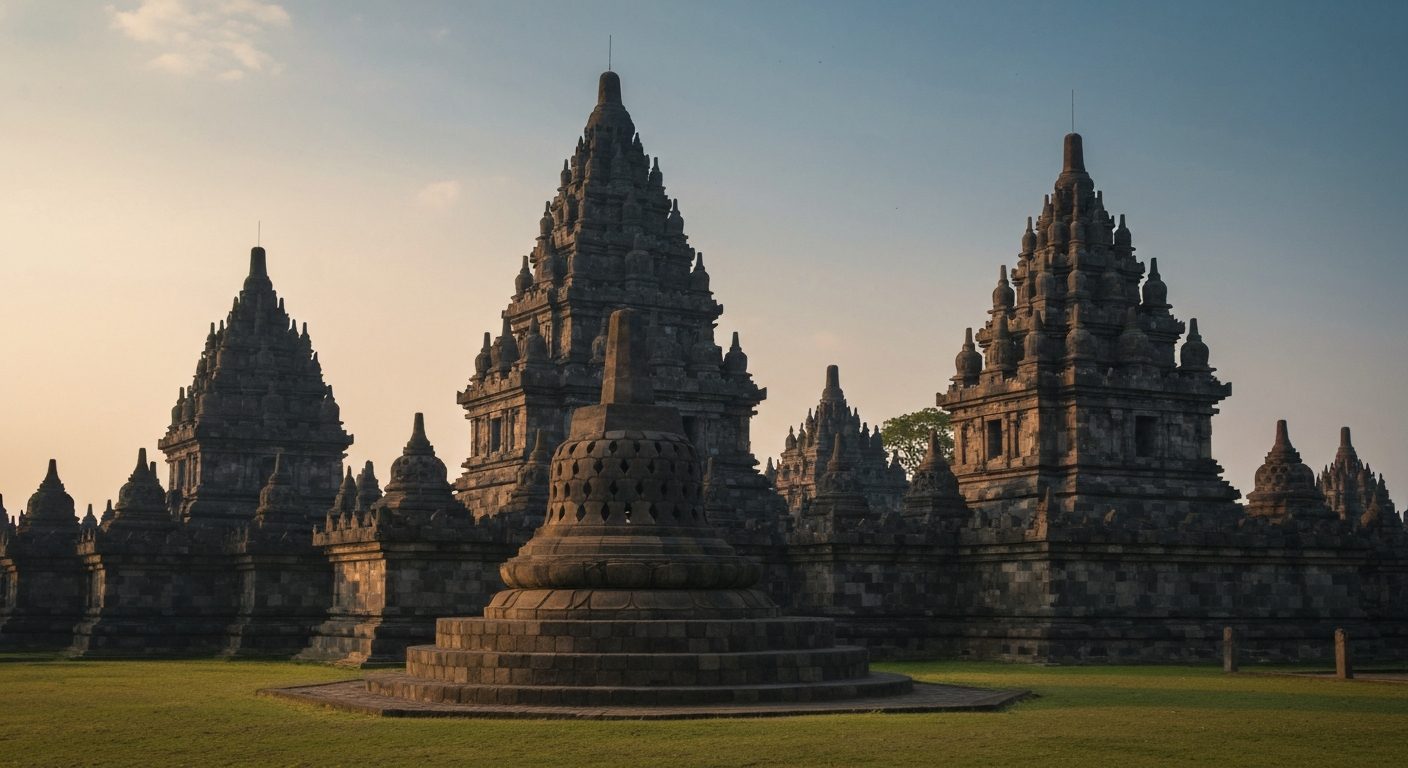
For many visitors to Yogyakarta, the question of Borobudur vs Prambanan is one of the first and most significant planning hurdles. Should you see Borobudur first, or Prambanan? These two UNESCO World Heritage sites represent the pinnacle of ancient Javanese architecture and spirituality, yet they offer distinctly different experiences.
As someone who has walked these temple grounds for over a decade, observing their rhythms from dawn to dusk, I can tell you that the most rewarding answer for most travelers is to experience both. Borobudur and Prambanan, despite their differences in faith and form, complement each other beautifully, telling a broader story of Java’s rich past. Planning to see both in a single, well-structured day often makes the most sense.
Borobudur vs Prambanan: A Head-to-Head Comparison
To help you understand the core distinctions and decide how to best integrate them into your itinerary, let’s lay out the key facts side-by-side. This comparison focuses on the practicalities and the essence of what each temple offers.
- Primary Faith Represented
- Borobudur: Mahayana Buddhism. It is the world’s largest Buddhist temple, designed as a massive stupa and a spiritual path to enlightenment.
- Prambanan: Trimurti Hinduism. A complex of towering candi (temples) dedicated to Brahma, Vishnu, and Shiva.
- Architectural Style & Form
- Borobudur: A monumental stepped pyramid, resembling a mountain, adorned with thousands of intricate bas-reliefs and hundreds of bell-shaped stupas. Its design is symbolic of the Buddhist cosmos.
- Prambanan: A collection of tall, slender temple towers with elaborate carvings, reaching skyward. The central compound houses three main temples dedicated to the Hindu trinity, surrounded by smaller shrines.
- Typical “Best Time” to Visit
- Borobudur: Sunrise. The iconic experience involves arriving before dawn to witness the sun rise over the surrounding volcanoes, casting light upon the stupas.
- Prambanan: Late afternoon/Sunset. The golden light illuminates the stone, and it precedes the Ramayana Ballet performance, which is often held nearby.
- Approximate Distance from Yogyakarta City
- Borobudur: ~40 km to the northwest, about a 1-hour drive.
- Prambanan: ~17 km to the east, about a 30-minute drive.
- Time Needed for a Full Visit
- Borobudur: 2-3 hours for a thorough exploration, especially if you ascend all levels and appreciate the reliefs.
- Prambanan: 1.5-2.5 hours to walk through the main complex and visit some of the surrounding smaller temples.
- Crowd Dynamics
- Borobudur: Very busy at sunrise; crowds taper off through the late morning. Can feel very packed at peak times.
- Prambanan: Consistently busy during the day, peaking in the late afternoon, especially if there’s a Ramayana Ballet show.
- Foreign Adult Ticket Price Range (last verified June 2026)
- Borobudur: Regular entry around US$25-30. Special sunrise tickets (often through Manohara or designated operators) can range from US$30-40, offering earlier access.
- Prambanan: Regular entry around US$25-30. A combined ticket for Borobudur & Prambanan is often available for around US$45-50, offering a slight discount.
- Associated Cultural Performance
- Borobudur: No regular performance. The focus is on the temple itself and its spiritual journey.
- Prambanan: Ramayana Ballet. An epic Javanese dance-drama telling the story of Rama and Sita, often performed outdoors with Prambanan’s illuminated spires as a backdrop.
- Is Borobudur or Prambanan Bigger?
- Borobudur: In terms of sheer volume and footprint, Borobudur is generally considered larger. It’s a single, massive structure. Its base measures approximately 123 x 123 meters.
- Prambanan: While impressive, it is a complex of many individual structures, with the tallest temple (Shiva Temple) reaching 47 meters high. The entire archaeological park spans a significant area, but the individual temples are more slender.
Borobudur Temple: The Dawn of Enlightenment
Borobudur is more than just a temple; it is a profound journey cast in stone. Rising majestically from a plain surrounded by volcanoes, this 9th-century Buddhist monument is a silent testament to ancient engineering and spiritual devotion.
Why Visit Borobudur?
The experience of Borobudur is deeply immersive. Walking its ascending terraces is meant to be a physical and spiritual pilgrimage, symbolizing the path to enlightenment. Each level represents a different realm of Buddhist cosmology, adorned with thousands of detailed bas-reliefs that narrate the life of Siddhartha Gautama and Buddhist teachings. These carvings are not just decorative; they are a visual scripture, guiding the devotee upwards.
For many, the primary draw is the Borobudur sunrise. Arriving in the cool predawn darkness, you ascend the temple’s steps, finding a spot amidst others who have made the early start. As the sky lightens, mist often hangs low over the rice fields, and the surrounding volcanoes (Merapi and Merbabu) emerge from the haze. Then, the sun crests the horizon, bathing the bell-shaped stupas and their seated Buddha statues in a soft, golden light. It is a moment of quiet awe, a powerful connection to history and nature. While undoubtedly crowded, especially during peak season, the shared experience often fosters a unique sense of camaraderie.
The sheer scale of Borobudur is humbling. Its intricate detail, from the expressive faces on the reliefs to the openwork design of the stupas, reveals the skill and artistry of its builders. Spend time with the reliefs, tracing the stories. Look closely at the Dhyani Buddhas, each with a distinct hand gesture (mudra) pointing to a cardinal direction. The temple invites contemplation.
Practicalities for Borobudur
Borobudur is located in Magelang, central Java, about 40 kilometers northwest of Yogyakarta. The drive from Yogyakarta city takes approximately one hour.
Tickets: Regular park entry for foreign adults currently costs around US$25-30. For the iconic sunrise experience, you typically need to purchase a special “sunrise ticket.” This is often facilitated by designated operators or the Manohara Hotel, which is located within the temple complex. These tickets grant access before the general public and generally range from US$30-40. It’s advisable to book these in advance, especially during high season.
Time Needed: Plan for at least 2-3 hours to fully appreciate Borobudur. This allows time to ascend to the top, walk around the circular terraces, examine the reliefs, and simply absorb the atmosphere. The early start for sunrise means you’ll be finished by late morning, leaving your afternoon open.
What to Expect: Be prepared for a fair amount of walking and climbing steps. The temple can be slippery when wet, so comfortable, sturdy shoes are a must. Bring a light jacket for the cool predawn hours, even if the day promises to be warm.
Crowds: Borobudur is a major attraction. Expect crowds, especially for sunrise. While the temple is vast, the upper levels can feel quite busy. Patience and an appreciation for the shared experience go a long way.
Prambanan Temple: A Symphony in Stone
In stark contrast to Borobudur’s serene, mound-like form, Prambanan bursts upwards, a dramatic complex of towering Hindu temples. This 9th-century marvel is dedicated to the Trimurti – Brahma the Creator, Vishnu the Preserver, and Shiva the Destroyer – and is a powerful expression of Hindu belief in Java.
Why Visit Prambanan?
Prambanan captivates with its grandeur and intricate detail. The central compound, known as the “Loro Jonggrang” complex, features three main temples dedicated to the Trimurti, flanked by smaller temples for their animal vehicles (vahanas). The tallest and most impressive is the 47-meter-high Shiva temple, adorned with magnificent carvings depicting Hindu deities and mythical creatures.
Walking through Prambanan feels like exploring an ancient city of gods. The architectural style is notably different from Borobudur: sharp, angular spires reaching for the sky, covered in delicate, almost lace-like carvings. The bas-reliefs here tell tales from the Hindu epic Ramayana, depicting the adventures of Prince Rama and his loyal monkey general Hanuman. These narratives are dynamic and full of action, a different storytelling style than Borobudur’s more contemplative Buddhist reliefs.
A significant draw for Prambanan is the Ramayana Ballet. This spectacular performance, often held in an open-air theater with the illuminated temples as a backdrop during dry season, brings the epic to life through traditional Javanese dance, gamelan music, and vibrant costumes. It is a captivating cultural experience that beautifully complements a visit to the temple itself. Seeing the stories you’ve just admired in stone performed live is truly special.
The best time to visit Prambanan is often in the late afternoon, as the setting sun casts a warm glow on the ancient stone. The atmosphere shifts from bright daylight exploration to a more dramatic, almost theatrical setting as dusk approaches.
Practicalities for Prambanan
Prambanan is conveniently located about 17 kilometers east of Yogyakarta city, making it a relatively short 30-minute drive.
Tickets: Regular park entry for foreign adults currently costs around US$25-30. As mentioned, a combined ticket for Borobudur & Prambanan can be purchased for around US$45-50. Ramayana Ballet tickets are separate and vary widely depending on seating class, ranging from approximately US$10-33 (IDR 150,000-500,000).
Time Needed: Allocate 1.5-2.5 hours to explore the main Prambanan complex, including the Trimurti temples and the surrounding smaller shrines. If you plan to attend the Ramayana Ballet, factor in additional time for the show itself (usually about 2 hours) and travel to the performance venue.
What to Expect: Prambanan involves a fair amount of walking on open, paved grounds. The pathways are generally flat. There are fewer steep climbs than Borobudur, but you will ascend steps to enter the main temples. The area can be very warm and exposed to the sun, so hats, sunscreen, and water are essential.
Crowds: Prambanan is a popular destination and can be busy throughout the day. Peak times are often in the late afternoon, especially when tour groups arrive before the Ramayana Ballet.
Borobudur and Prambanan Same Day: The Ultimate Combination
Many visitors wonder if it’s feasible to visit Borobudur and Prambanan in one day. The answer is a resounding yes, and for those with limited time, it often becomes the most efficient and rewarding way to experience both. This “Borobudur sunrise Prambanan sunset combo” is a classic itinerary, providing a full day of cultural immersion.
The key to a successful same-day visit is an early start and efficient planning. You begin before dawn for the Borobudur sunrise. After spending a couple of hours at Borobudur, you’ll typically be finished by 8:30-9:30 AM.
Slotting in the Merapi Lava Tour
This mid-morning slot, between Borobudur and Prambanan, is geographically perfect for integrating another unique Yogyakarta experience: the Merapi Lava Tour. Merapi, one of the world’s most active volcanoes, offers a rugged jeep adventure through the areas affected by its past eruptions.
The Merapi jeep tour isn’t a “vs Borobudur” situation; it’s a complementary experience that adds another dimension to your day. While Borobudur offers ancient spirituality and Prambanan showcases historical grandeur, Merapi provides a raw, natural spectacle and a glimpse into the resilience of local communities living in the shadow of an active volcano.
From Borobudur, you’ll travel towards the north of Yogyakarta, to the base of Mount Merapi. This drive typically takes around 1.5 hours. A Merapi jeep tour usually lasts 2-3 hours, taking you through the “lava fields,” past abandoned villages, and to viewpoints offering dramatic perspectives of the volcano. A short route (2-3 pax) typically costs around US$25-40 (IDR 400,000-600,000) per jeep. This tour usually concludes by early afternoon.
From Merapi’s base, it’s then a relatively straightforward drive (about 1 hour) to Prambanan, positioning you perfectly for a late afternoon visit and potentially the Ramayana Ballet.
This itinerary, while long, is incredibly fulfilling. You transition from the serene Buddhist dawn, through the stark volcanic landscape, to the dramatic Hindu sunset, often culminating in an epic dance performance. It’s a full spectrum of Javanese experience packed into one memorable day.
Which Java Temple to See: Making Your Choice
While I firmly believe that both Borobudur and Prambanan are worth it and offer distinct, enriching experiences, sometimes travel plans or personal preferences dictate a choice. If you truly can only visit one, consider these points:
- Choose Borobudur if: You are drawn to spiritual journeys, monumental architecture, and the allure of an iconic sunrise experience. You appreciate intricate narratives told through bas-reliefs and the meditative quality of a vast, ancient monument. The question “is Borobudur or Prambanan bigger” often leads people to Borobudur for its sheer mass.
- Choose Prambanan if: You prefer dramatic, soaring architecture, the grandeur of Hindu mythology, and the option to combine your temple visit with a captivating cultural performance like the Ramayana Ballet. Its closer proximity to Yogyakarta can also be a deciding factor for some.
Regarding “Borobudur Prambanan tour which better,” neither is inherently “better.” They are different. Borobudur offers quiet majesty and a profound spiritual ascent. Prambanan offers dynamic splendor and theatrical storytelling. Your personal interests should guide your choice if you are limited to one. Both are absolutely “worth it” in their own right.
Planning Your Trip with Prambanan Tours
Arranging a multi-stop, full-day itinerary like the Borobudur sunrise, Merapi jeep, and Prambanan sunset combo requires careful coordination. This is where Prambanan Tours, operated by Bali Premium Trip, excels. We specialize in crafting honest, research-backed itineraries, providing transparent ticket and price breakdowns, and offering best-time guidance tailored to your preferences.
We arrange private, expert-guided trips with licensed, vetted on-ground Yogyakarta guides and operators. Our team handles all transfers, permits, and bookings honestly – we arrange these services with trusted local partners; we do not own park permits or concessions ourselves. You can book directly with our own Bali Premium Trip reservations team at transparent, published rates, ensuring a smooth and confident journey without third-party markups. We’ve run these routes for years and understand what makes a visit truly meaningful.
Plan your trip with us. For personalized assistance and to discuss your ideal itinerary, reach out via WhatsApp at +6281128590000. Let us take the complexity out of planning, so you can focus on the wonder of Java’s ancient heritage.
***
Frequently Asked Questions
Is Borobudur or Prambanan bigger?
In terms of overall mass and footprint, Borobudur is generally considered larger, as it is a single, massive stepped pyramid structure measuring approximately 123 x 123 meters at its base. Prambanan, while an extensive complex, consists of many individual, more slender temples, with the tallest (Shiva Temple) reaching 47 meters in height.
What is the difference between Borobudur and Prambanan?
The primary difference lies in their religious affiliation and architectural styles. Borobudur is the world’s largest Buddhist temple, designed as a large, ascending stupa, embodying a path to enlightenment with serene bas-reliefs. Prambanan is a Hindu temple complex, characterized by towering, slender spires dedicated to the Trimurti (Brahma, Vishnu, Shiva), adorned with dynamic carvings depicting stories from the Ramayana epic. Their atmospheres also differ, with Borobudur often feeling more contemplative and Prambanan more dramatic.
Can you visit Borobudur and Prambanan in one day?
Yes, it is definitely possible and a popular itinerary for many visitors to Yogyakarta. A common approach involves an early start for Borobudur sunrise, followed by a mid-day activity like the Merapi Lava Tour, and concluding with a late afternoon visit to Prambanan, often followed by the Ramayana Ballet. This makes for a long but incredibly rewarding day.
Is the Merapi Jeep Tour better than Borobudur?
The Merapi Jeep Tour is not “better” than Borobudur; it offers a completely different type of experience. Borobudur is an ancient cultural and spiritual monument, while the Merapi Jeep Tour provides an adventurous encounter with an active volcano and its raw natural landscape. They complement each other well, and many travelers choose to include the Merapi tour between a morning visit to Borobudur and an afternoon visit to Prambanan to diversify their day’s activities.
Which temple should I visit first, Borobudur or Prambanan?
If you plan to visit both in one day, Borobudur is almost always visited first to experience its iconic sunrise. If you can only visit one, your choice depends on your interests: choose Borobudur for a profound spiritual journey and monumental Buddhist architecture, or choose Prambanan for dramatic Hindu spires, intricate carvings, and the option to see the Ramayana Ballet.